Table of contents
This article refers to the following from the FIFA regulations:
- Article 21 and Annexe 5 to the FIFA Regulations on the Status and Transfer of Players (RSTP)
- Chapter 8 of the Commentary on the RSTP
- Section 2 of the FIFA Clearing House Regulations (FCHR)
Introduction
Under the solidarity mechanism, 5% of any compensation paid within the scope of a player’s transfer, not including training compensation paid to the former club, must be deducted from the total amount of this compensation and distributed by the new club as a solidarity contribution to the club(s) involved in the player’s training and education over the years. This means that solidarity contributions are proportional to the transfer compensation paid for the player.
This framework is based on the notion of solidarity within the football community and applies to both men’s and women’s football.
Solidarity mechanism triggers
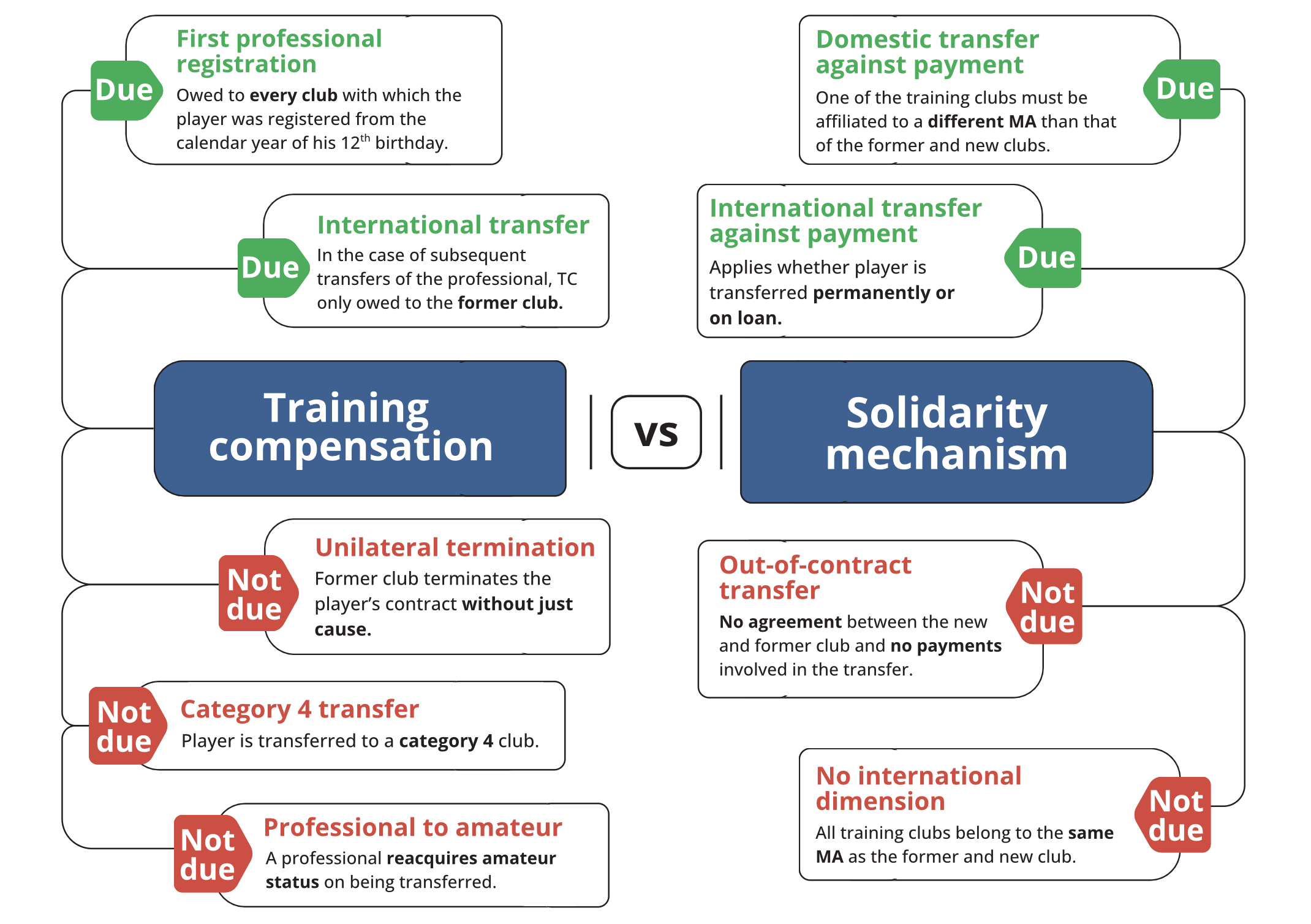
Solidarity contributions are due anytime a professional player is transferred against transfer compensation, whether on a definitive or loan basis:
- if the transfer is between clubs affiliated to different Member Associations; or
- if the transfer is between clubs affiliated to the same Member Association and the transfer has an international dimension, i.e. at least one of the training clubs is affiliated to a different Member Association.
The solidarity mechanism is not limited by the player’s age at the time of the transfer and may be triggered more than once during the player’s career.
All types of transfer compensation paid by the new club to the former club, regardless of whether they are described as part of the transfer fee or not, are subject to the solidarity mechanism, including fixed transfer fees, conditional fees, sell-on fees and buy-out fees.
The summary below compares of solidarity contribution triggers, in comparison with triggers for training compensation.
Entitlement to solidarity contributions
If the solidarity mechanism applies, clubs that trained the player between the ages of 12 and 23 may be entitled to a solidarity contribution. This right is not linked to a specific age limit, and the same club may receive a solidarity contribution more than once during the player’s career, if the player transfers to different clubs.
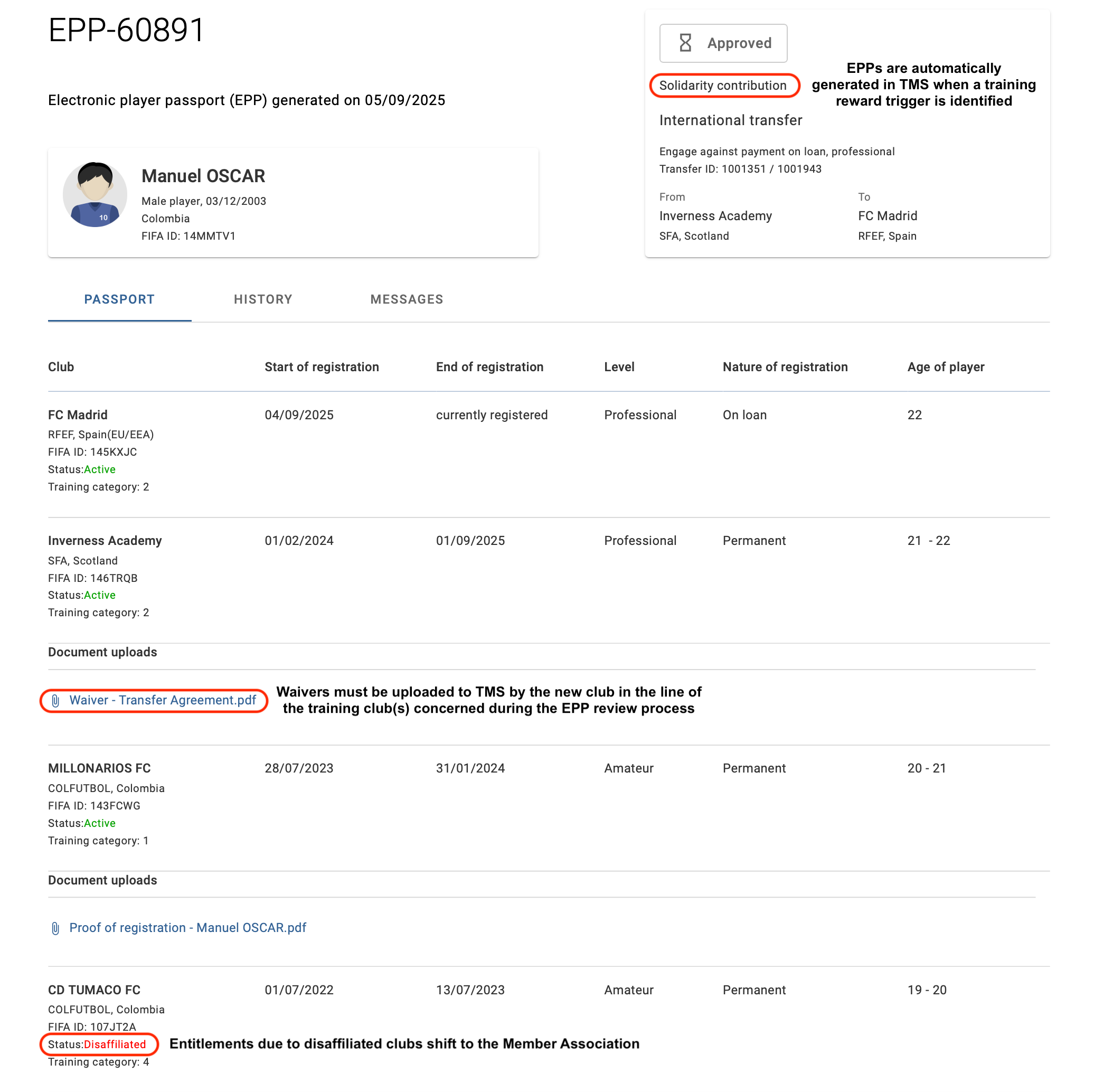
If a training club is entitled to a solidarity contribution but is disaffiliated or no longer exists because of bankruptcy, liquidation, etc., the entitlement shifts to the Member Association to which the training club was affiliated, and the funds are to be used for national youth football development programmes.
Waiver of solidarity contributions
Training clubs may waive their entitlement to solidarity contributions via a waiver that must:
- identify the specific club renouncing its right to training rewards;
- detail the type of compensation being waived;
- identify the player by name and another identifier, such as date of birth or FIFA ID; and
- specify the transfer for which the waiver is valid.
The new club must upload the valid waiver to the relevant training club’s line during the appropriate step of the EPP review process. If the EPP was triggered for both training compensation and a solidarity contribution, upload it under “Solidarity Contribution Waiver”. If the EPP was triggered only for a solidarity contribution, upload it under “Waiver”. Waivers submitted after the EPP becomes final and binding will not be considered.
Training clubs cannot transfer their entitlement to a third club via the waiver.
For more information, see “ Submitting a waiver of training club’s right to receive training rewards”.
Solidarity contributions due to the former club
All training clubs are treated the same way, regardless of whether they are parties to the transfer itself. The former club should therefore benefit from the solidarity contribution if it contributed to the player’s training and education over the relevant period.
If the releasing club is also a training club, it should receive 95% of the agreed transfer fee from the new club plus its portion of the solidarity contribution. This portion of the solidarity mechanism is calculated in the allocation statement based on the EPP determination and must be exclusively distributed through the FIFA Clearing House.
In cases where the former and new clubs agree, as part of the player’s transfer, that the solidarity contribution to the former club is included in the transfer compensation, the new club must upload the transfer or loan agreement during the EPP review process in the “Waiver” section in relation to the registration of the player at the former club. Payments of solidarity contributions to other training clubs, where applicable, must be processed through the FIFA Clearing House.
Practical example
The EPP example below illustrates key principles related to the entitlement of clubs to the solidarity contribution.
Calculation of solidarity contributions
Solidarity contributions are calculated as a percentage of the agreed transfer compensation where up to 5% of any compensation paid, not including training compensation paid to the former club, must be deducted from the total amount of this transfer fee for payment of the solidarity contribution.
The amounts due to training clubs are based on the number of years the player was registered with the relevant club(s) between the calendar years of their 12th and 23rd birthdays, as follows:
- Calendar year of 12th birthday: 5% of 5% of any compensation
- Calendar year of 13th birthday: 5% of 5% of any compensation
- Calendar year of 14th birthday: 5% of 5% of any compensation
- Calendar year of 15th birthday: 5% of 5% of any compensation
- Calendar year of 16th birthday: 10% of 5% of any compensation
- Calendar year of 17th birthday: 10% of 5% of any compensation
- Calendar year of 18th birthday: 10% of 5% of any compensation
- Calendar year of 19th birthday: 10% of 5% of any compensation
- Calendar year of 20th birthday: 10% of 5% of any compensation
- Calendar year of 21st birthday: 10% of 5% of any compensation
- Calendar year of 22nd birthday: 10% of 5% of any compensation
- Calendar year of 23rd birthday: 10% of 5% of any compensation
The proof of payment declared by the new club in the transfer instruction is key in the calculation of the solidarity contribution as the amount declared as paid will always be considered to represent 95% of the agreed transfer compensation (or instalment thereof), with the remaining 5% having been withheld. This method of calculating and paying solidarity contributions is known as “95+5”.
Top-up payments
Should the solidarity contribution due to training clubs be calculated as less than the 5% withheld by the new club, the remaining amount, known as the “top-up”, is considered due to the former club as part of the transfer fee. This ensures that the new club does not pay less than the total amount it originally agreed to pay in transfer compensation and solidarity contributions.