Table of contents
This article refers to the following from the FIFA regulations:
- Article 20 and Annexe 4 to the FIFA Regulations on the Status and Transfer of Players (RSTP)
- Chapter 8 of the Commentary on the RSTP
- Section 2 of the FIFA Clearing House Regulations (FCHR)
Introduction
As a general rule, training compensation is payable until the end of the calendar year of a player’s 23rd birthday for training provided up to the age of 21, unless it is evident that the player completed their training before turning 21. The training compensation framework is intended to reward clubs that invest in training and educating young players who become professionals or are transferred to another club early in their career.
It is important to note that the obligation to pay training compensation is without prejudice to any obligation to pay compensation for breach of contract.
Note: The principles of training compensation do not currently apply to women’s football, but a governing framework was approved by the FIFA Council on 17 December 2023. The FIFA administration continues to consult stakeholders as part of ongoing efforts to promote the development of women’s professional football.
Training compensation triggers
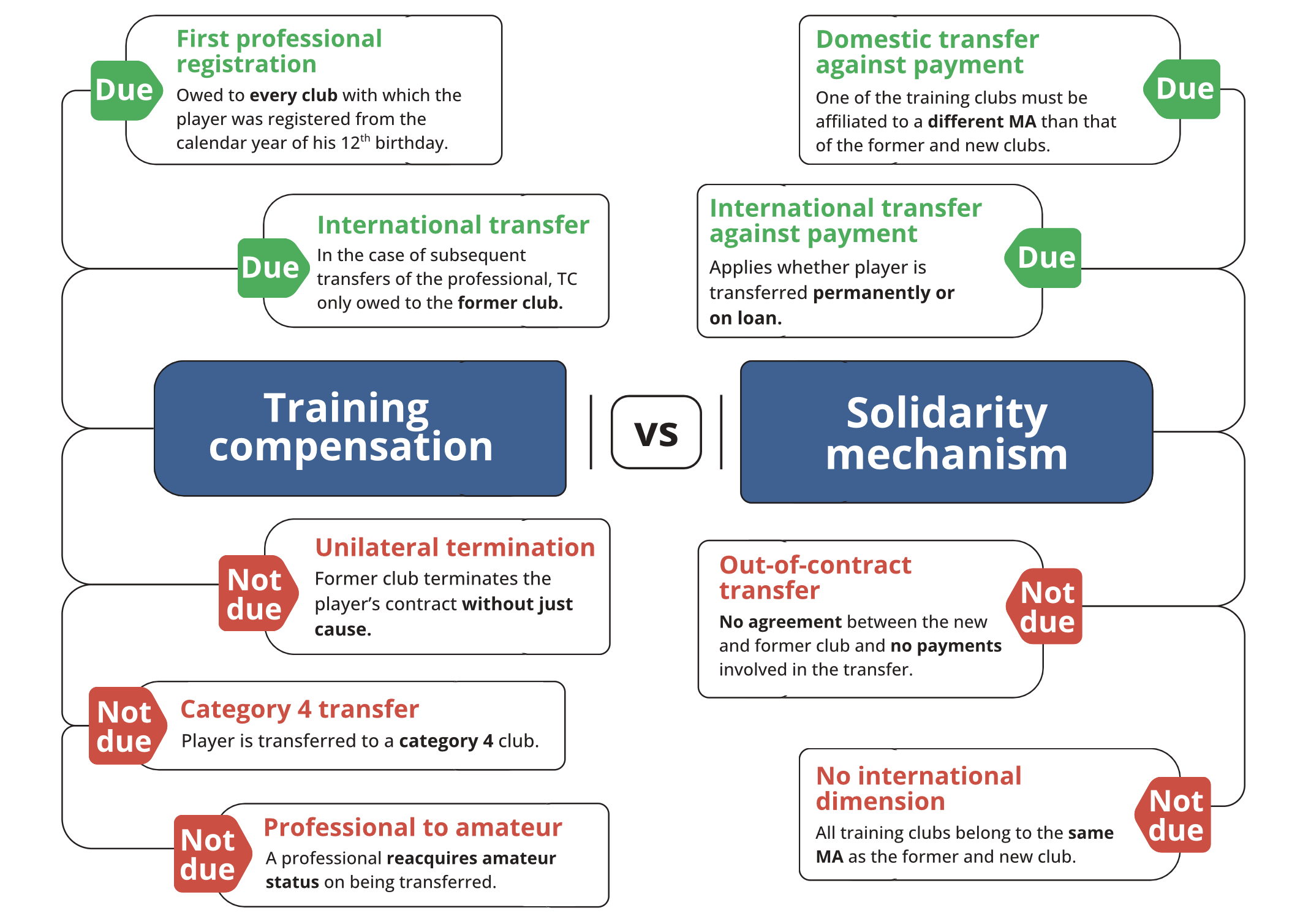
Training compensation is due:
- when a player is registered for the first time as a professional; and
- each time a professional player is transferred internationally until the end of the calendar year of their 23rd birthday. The transfer may occur during or at the end of their contract.
Training compensation is not due if:
- the former club terminates the player’s contract without just cause (without prejudice to the rights of the previous clubs);
- a player terminates their contract with their former club with just cause;
- the player is transferred to a category 4 club; or
- a professional reacquires amateur status on being transferred.
See below a summary of training compensation triggers, in comparison with triggers for the solidarity mechanism.
Entitlement to training compensation
If training compensation is due, clubs that trained the player between the calendar year of their 12th and 21st birthdays are entitled to receive training compensation once, if at all, based on the principle that the signing of a professional “breaks the chain”, i.e. ends their training. The entitlement of clubs is determined as follows:
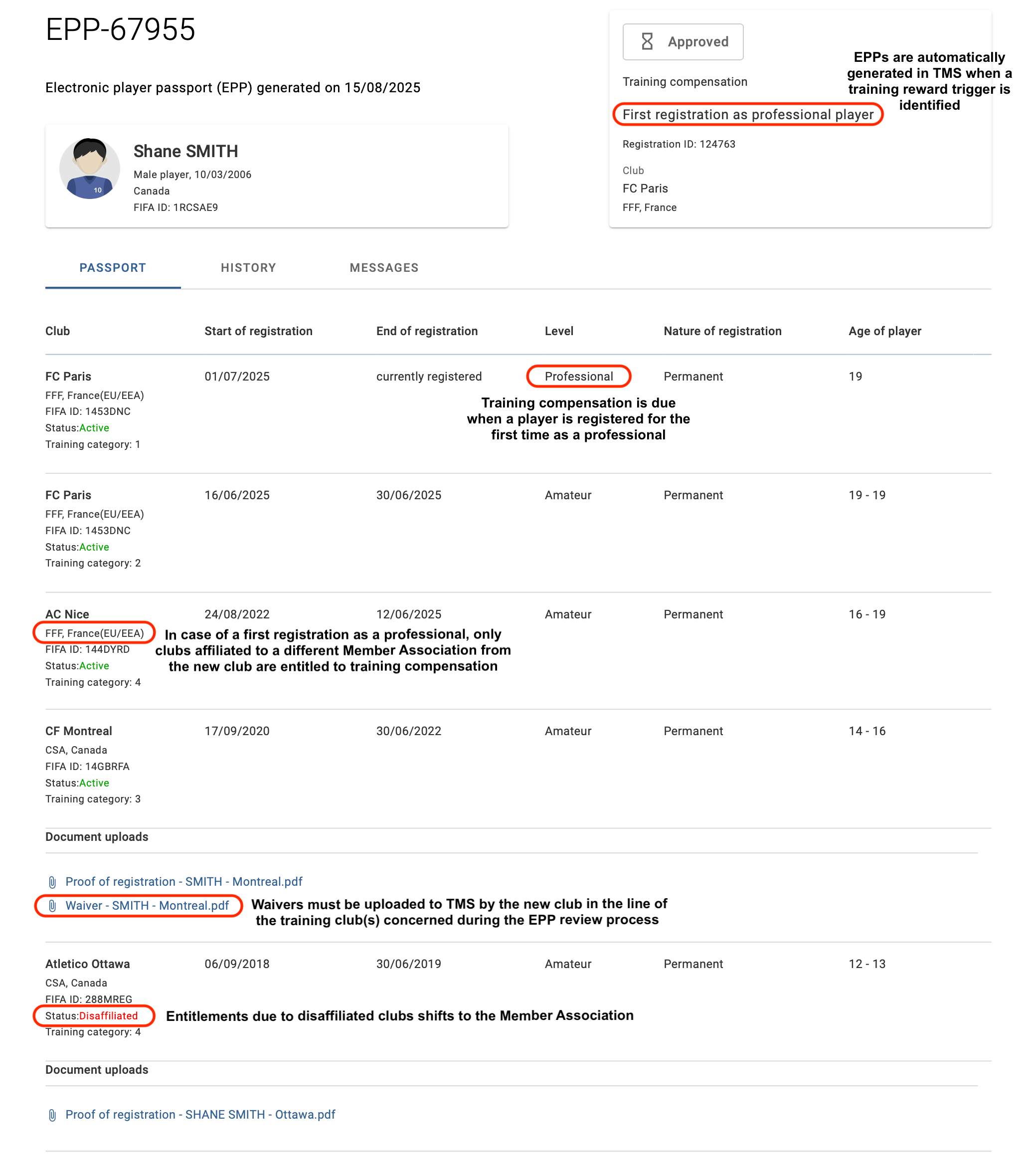
- When a player registers as a professional for the first time, only clubs affiliated to a different Member Association from the new club are entitled to training compensation. For clubs affiliated to the same Member Association as the new club, any entitlement to training compensation will depend on the relevant national regulations and the system to reward training clubs that each Member Association has put in place.
- When a player registers as a professional at the same club where the player has been trained for their whole career, this registration does not “break the chain”. Should training compensation be triggered by a subsequent transfer, the club is able to claim training compensation for the entire period over which it trained the player as both an amateur and a professional.
- When a player transfers internationally as a professional before the end of the calendar year of their 23rd birthday, the former club is in principle entitled to training compensation which is presumed to be included in any agreed transfer compensation, unless expressly indicated otherwise in the transfer agreement.
- When a player re-registers as a professional within 30 months of being registered as an amateur, the clubs with which the player was registered as an amateur directly prior to their “re-registration” as a professional are entitled to training compensation.
If a training club is entitled to training compensation but is disaffiliated or no longer exists because of bankruptcy, liquidation, etc., the entitlement shifts to the Member Association to which the training club was affiliated, and the funds are to be used for national youth football development programmes.
Note: special provisions apply for transfers between clubs affiliated to different Member Associations within the territory of the European Union/European Economic Area (EU/EEA).
Loan jurisprudence
When a professional player moves permanently, no later than the calendar year of their 23rd birthday, from their former club to a third (new) club affiliated to a different Member Association, after having been on loan from the former club to one or more loaning clubs, training compensation would in principle be due to the former club. However, the Dispute Resolution Chamber has extended the training entitlement of the former club to the club(s) where the player was on loan from the former club.
If the player was loaned by the former club to one or more clubs based in the European Union/European Economic Area, the club(s) where the player was loaned would not have to meet the contract offer requirements.
Waiver of training compensation
Training clubs may waive their entitlement to training compensation via a waiver that must:
- identify the specific club renouncing its right to training rewards;
- detail the type of compensation being waived;
- identify the player by name and other details such as date of birth and FIFA ID; and
- specify the transfer for which the waiver is valid.
The new club must upload the valid waiver to the relevant training club’s line during the appropriate step of the EPP review process. Waivers submitted after the EPP becomes final and binding will not be considered.
Training clubs cannot transfer their entitlement to a third club via the waiver.
For more information, see “Submitting a waiver of training club’s right to receive training rewards”.
Training compensation due to the former club
Unless otherwise specified in the transfer agreement, training compensation due to the former club is deemed included in the transfer compensation agreed for the transfer of the player.
Notwithstanding the above, in all cases of international transfers with transfer compensation and where there is a possible entitlement to training compensation, TMS will generate an EPP for the calculation of training compensation and the solidarity contribution. In cases of international transfers without transfer compensation and where there is a possible entitlement to training compensation, an EPP is generated for training compensation only.
During the review phase of the EPP, the new club must upload a copy of the relevant agreement as evidence that no training compensation to the former club is due in cases of international transfers with transfer compensation. During the EPP review process in TMS, these transfer agreements must be uploaded in the “Training Compensation Waiver” section in the relevant EPP.
Practical example
See below an EPP example that illustrates key principles related to the entitlement of clubs to training compensation.
Calculation of training compensation
The training compensation due to eligible training clubs is calculated based on the club category of the new club. Each club category is assigned training costs corresponding to the amount needed to train one player for one year multiplied by an average “player factor”, which is the ratio of players who need to be trained to produce one professional player.
The training costs associated with each club category are set by FIFA. Member Associations are responsible for ensuring that the correct club category is assigned in TMS to guarantee the accurate calculation of training compensation.
Note: The training costs and categorisation of clubs for the year 2025 are established in Circular no. 1936.
Overall, because the club categories reflect the clubs’ financial investment in training players, this calculation ensures that the new club is paying training clubs an amount equivalent to the costs it would have incurred had it trained the player itself.
Using these criteria, training compensation is calculated by multiplying the new club’s training costs by the player’s period of training with each eligible club. The period is calculated pro rata to the nearest day.
Note: training compensation for training provided during the calendar years of a player’s 12th to 15th birthdays is calculated by taking the annual training costs of a category 4 club in the new club’s confederation and multiplying them by the number of years of training.
For players moving between clubs affiliated to different Member Associations within the territory of the European Union/European Economic Area, the amount of training compensation payable is established based on the following:
- If the player moves from a lower- to a higher-category club, the calculation is based on the average training costs of the two clubs.
- If the player moves from a higher to a lower category, the calculation is based on the training costs of the lower-category club.
For more information, see “Special provisions for training compensation within the European Union/European Economic Area”.